Financial Aid
An OBBBA Resource Hub for Career-Focused Institutions
The OBBBA introduces many substantial changes in financial aid. But what exactly are these changes, how will they impact your students, and how should your school prepare?
On this page you'll find resources for understanding the bill and its impact on higher education. Check back often for new content, upcoming events, more questions answered, and up-to-date information.
Explore topics:
What is OBBBA? | Expert Webinars | Articles | FAQs | Resources | CORE Software

Did you know?
Key deadlines
Commonly known as the "One Big Beautiful Bill Act" (OBBBA), Public Law 119-21 goes into effect on July 1, 2026. This legislation amends key parts of Title IV of the Higher Education Act, including federal financial aid programs like Pell Grants and federal student loans.
Here's a quick summary of how the changes in the bill will impact financial aid:
These limits replace the previous structure in which graduate and parent borrowers could borrow up to the full cost of attendance, however legacy provisions do exist.
Existing income-driven plans (such as SAVE, PAYE) are phased out for new borrowers. Borrowers with loans taken before July 1, 2026 can continue current plans until June 30, 2028, after which only the RAP and standard repayment plan remain available for them. This consolidation aims to simplify repayment but also reduces borrower choice.
For loans made on or after July 1, 2027:
The OBBBA updates the federal need analysis system used to determine eligibility for need-based aid (like Pell Grants).
Under the new bill, there will be a new category of Pell Grants for students enrolled in short-term workforce programs (150–599 clock hours over 8–14 weeks) that meet labor-market relevance criteria. The law also provides additional funds in FY 2026 to help address a Pell Grant funding shortfall.
The law introduces a statutory earnings test for programs participating in the Direct Loan program. Beginning July 1, 2026, institutions must provide assurances that program completers’ earnings meet or exceed those of individuals without a comparable credential. This test adds a new layer of earnings-based accountability tied to institutional eligibility for federal aid programs.
For a more details on how these changes will affect students, read our blog post: How Will Financial Aid Changes Impact Career and Graduate Programs?
See NASFAA’S OB3 crosswalk for an overview of changes.
Beginning with the 2026-27 academic year (effective July 1, 2026), the requirement in proposed 34 CFR 685.203(m)(1) to adjust the annual loan limit for less-than-full-time enrollment applies to all undergraduate, graduate, and professional student Direct Loan borrowers—Direct Subsidized Loans, Direct Unsubsidized Loans, and graduate PLUS Loans for legacy borrowers. This includes students borrowing under the pre-July 1, 2026, legacy provisions (limited exceptions) and new borrowers on or after July 1, 2026.
Parent PLUS loans are not included in this proration requirement.
The OBBB reduces the amount of a loan that a student may borrow for an academic year if the student is enrolled in a program of study on less than a full-time basis during that academic year. This reduction in the annual loan limit will be made in direct proportion to the degree to which the student is not enrolled full-time, rounded to the nearest percentage point.
The schedule of reductions (SOR) methodology is::
number of credits enrolled for the academic year / number of credits defined as full time for program academic year x 100 and rounded to the nearest whole percent.
While the underlying concept of a professional program is not new, the creation of loan limits based on whether a program is professional versus graduate level is new. The law and accompanying regulations define what is considered professional for these new loan limits. Professional degrees are largely limited to: Pharmacy (Pharm.D.), Dentistry (D.D.S. or D.M.D.), Veterinary Medicine (D.V.M.), Chiropractic (D.C. or D.C.M.), Law (L.L.B. or J.D.), Medicine (M.D.), Optometry (O.D.), Osteopathic Medicine (D.O.), Podiatry (D.P.M., D.P., or Pod.D.), Clinical Psychology (Psy.D. or Ph.D.), and Theology (M.Div., or M.H.L.)
Graduate programs will continue unchanged in regard to annual limits with $20,500 being the limit, but the Professional programs can now borrow up to $50,000 in unsubsidized funds per academic year. Graduate PLUS loans are eliminated for any student not eligible for the legacy provision.
New aggregate limits also now apply with graduate programs limited to $100,000 and professional programs limited to $200,000. These aggregate limits do not include undergraduate borrowing.
Legacy provisions also apply to these OB3 changes. These permit students who have received a disbursement of Direct Loan in the same program of study at the same school prior to 7/1/26 to continue to borrow under the old regulations for an additional 3 academic years or until completion of the program whichever is less.
If the student withdraws, changes programs, or otherwise ceases enrollment, they lose the legacy provisions.
On June 24, 2026, the U.S. District Court for the District of Columbia, in consolidated cases Nos. 26-1780, 26-1941, preliminarily stayed part of the U.S. Department of Education’s (the Department’s) professional degree definition contained in the Reimagining and Improving Student Education (RISE) Final Rule published in the Federal Register on May 1, 2026. See the GEN-26-42 for more information.
The Grad PLUS loan program is being eliminated for new graduate and professional students as part of the OB3 overhaul. However, there is a legacy provision that permits students who have received a disbursement of Direct Loan in the same program of study at the same school prior to 7/1/26 to continue to receive Grad PLUS loans for an additional 3 academic years or until completion of the program whichever is less.
If the student withdraws, changes programs, or otherwise ceases enrollment, they lose the legacy provisions and would not be eligible for Grad PLUS loans if and when they reenroll.
Institutions seeking guidance should refer to the NASFAA OB3 Checklist as one of the first points of reference.
OB3 does not eliminate or reduce Pell Grants. In fact, it expands Pell eligibility for workforce programs while keeping traditional Pell awards intact. However, some students who were previously eligible for Pell grants may not be eligible in the 2026-27 award year and beyond.
What changed?
Previously, under the FAFSA Simplification Act family farms and family-owned small businesses would be counted as assets when an applicant filed the Free Application for Federal Student Aid (FAFSA®) form. This no longer applies.
The OBBBA reverses this requirement and expands on asset exemptions.
Beginning with the 2026–27 award year, the OBBBA updates the Student Aid Index (SAI) calculation to exclude the following from current net worth of businesses and farms:
The net worth of a family-owned business with 100 or fewer full-time (or full-time equivalent) employees.
The net worth of a farm on which the family resides, in addition to the existing exemption for a family's primary residence.
The net worth of a commercial fishing business and related expenses, owned and controlled by a family.
In all cases, the 2026-27 FAFSA is already applying these regulations at the point of processing. Nothing for you to do!
If a program is not eligible for the increased health professions amounts now, they do not become eligible due to the new professional definitions.
FSA stands for Federal Student Aid, an office of the U.S. Department of Education. It is the entity responsible for managing, processing, and overseeing all federal student financial assistance programs, including loans, grants, and work-study funds.
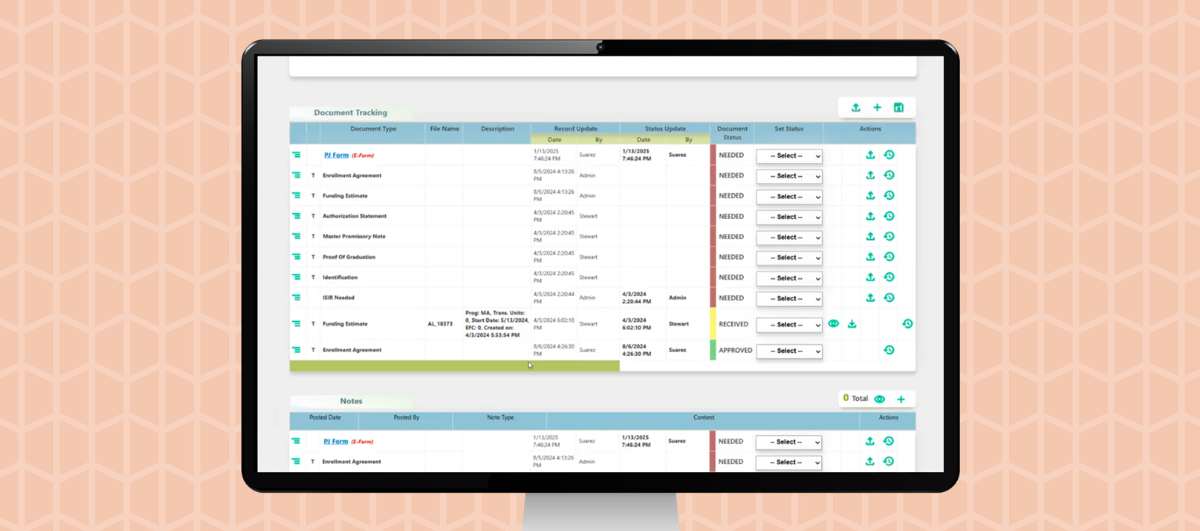
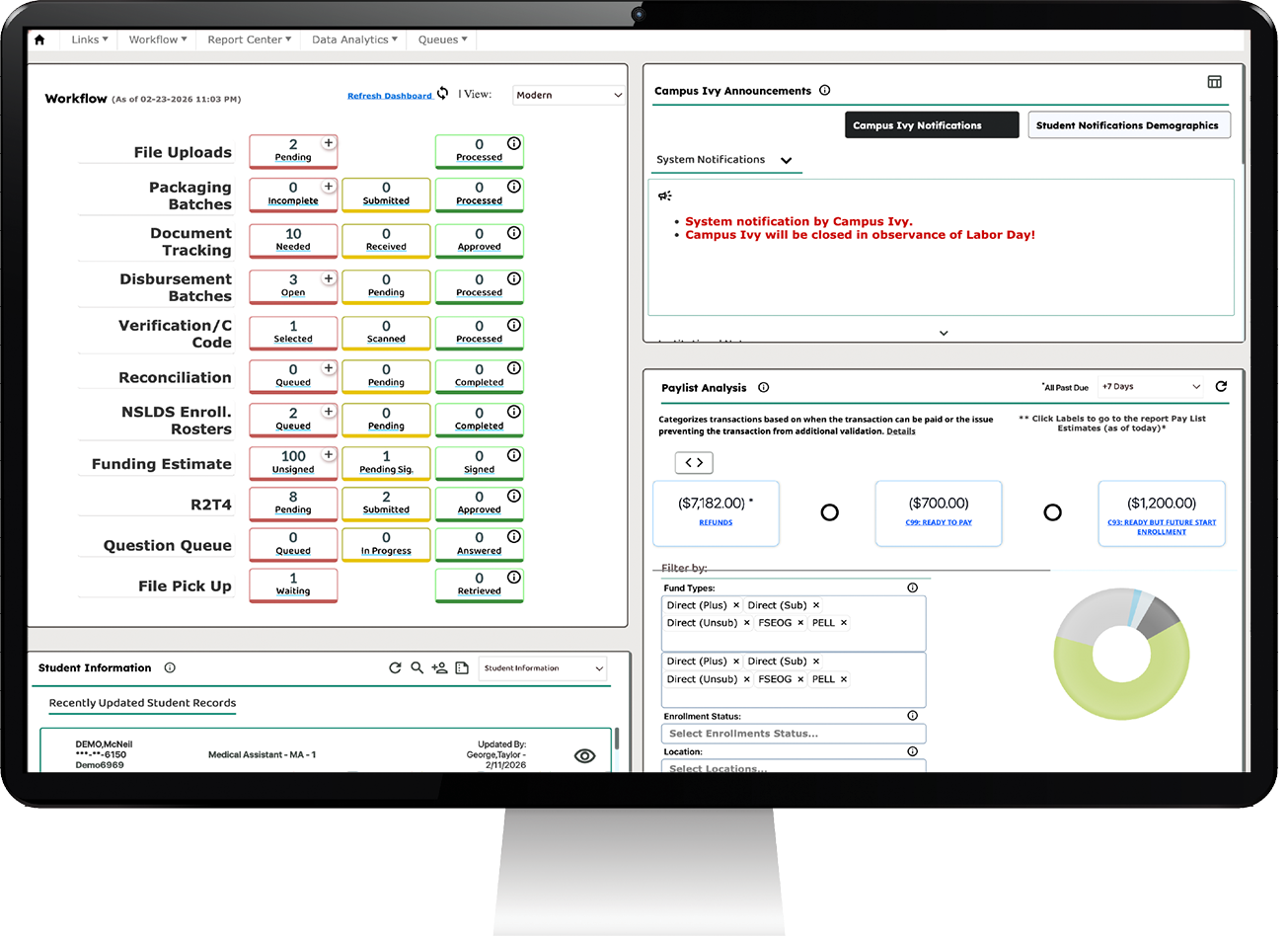
Portico’s Financial Aid Software (formerly Campus Ivy CORE) is built specifically for career schools. It supports all academic models, stays current with regulations, and connects seamlessly to your SIS and CRM. Whether you need cloud-based software or full-service support, Portico has your financial aid needs covered.

Here at Portico, we’re redefining how trade, technical, and vocational schools manage the student lifecycle.
Our technology combines enrollment, financial aid, and student success into one integrated platform that was specifically designed for career-focused institutions. Portico brings together four established EdTech leaders—Campus Ivy, CourseKey, and Verity IQ, and Trajecsys—into one integrated platform. Learn More.